
Artificial intelligence is no longer a future concept in wealth management. It is already reshaping how advice is delivered, scaled, and experienced. Research highlighted by Deloitte suggests AI-driven investment tools could become the primary source of advice for retail investors by 2027, with adoption expected to exceed 80% by 2028. Across the industry, firms are already embedding AI into advisory workflows, signaling a permanent shift in how advice is delivered.
As AI capabilities accelerate, a natural question has emerged: Will AI replace financial advisors?
The short answer is no. In wealth management, AI is increasingly used to support advisors by reducing administrative work, improving preparation, and strengthening consistency across client interactions. When implemented thoughtfully, AI enhances human judgment, trust, and relationship building rather than replacing the advisor-client relationship.
At Practifi, the answer is clear. The future of wealth management isn’t about replacing advisors with automation. It’s about using AI thoughtfully to support the uniquely human elements of advice: trust, empathy, judgment, and relationship building.
What the AI Debate Misses About Wealth Management Advisors
Wealth management has always been relationship driven. Clients don’t just want answers; they want reassurance, context, and confidence, especially during periods of uncertainty. While AI is making impressive strides in efficiency and analysis, those advances don’t diminish the importance of human connection; they amplify it.
The World Economic Forum frames this concern through what it calls the “trust equation,” which highlights four factors that shape client trust: credibility, reliability, intimacy, and self-orientation. AI can strengthen credibility and reliability by improving consistency and accuracy, but intimacy and judgment remain inherently human. That gap underscores why automation alone cannot replace the trust built through human relationships.
This reality points to a clear conclusion: the near-term future of AI is a hybrid model, where it can enhance human expertise, not replace it. AI excels at processing data, spotting patterns, and improving consistency, but it lacks lived experience, emotional intelligence, and the human understanding needed to build deep, trust-based relationships. Advisory success depends on recognizing unspoken concerns and responding with empathy, qualities only humans can deliver.
The Hybrid Model: Where AI Best Supports Advisors
As wealth management firms adopt AI, the most effective implementations embed intelligence directly into everyday workflows. Rather than introducing standalone tools, AI works best when it quietly supports preparation, follow-through, and consistency behind the scenes.
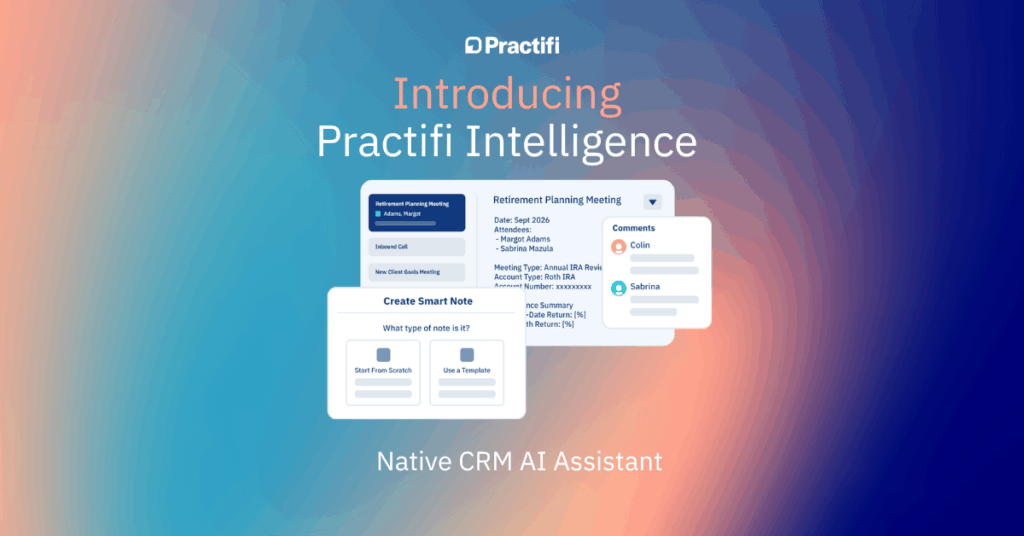
Practifi Intelligence was designed with this hybrid model in mind. By integrating AI into the CRM, it helps reduce administrative and cognitive friction across advisory work — from meeting preparation and documentation to relationship management and operational oversight. The goal is not to change how advisors engage with clients, but to give them more space to do it well.
Broadly, this approach focuses on three areas where AI can have the greatest impact:
- Meeting Intelligence
- Relationship Intelligence
- Admin Intelligence
Each reflects a simple principle: remove friction so advisors can focus on building trust, exercising judgment, and strengthening relationships.
Meeting Intelligence: Making Space for Better Client Conversations
Administrative overhead is one of the biggest drains on an advisor’s time, particularly during client meetings. When attention is split between clients and documentation, the quality of conversation suffers.
Meeting Intelligence addresses this challenge by automating meeting capture and follow-up. Instead of focusing on note-taking in real time, advisors can stay fully present, ask better questions, and engage more thoughtfully. Documentation is handled after the fact, creating a more natural and human client experience.
Importantly, this automation supports — rather than disrupts — compliance. Meeting records are securely documented within the CRM, helping firms meet regulatory requirements without adding manual steps or distracting from client conversations.
Relationship Intelligence: Preparing Advisors With the Right Client Context
Strong client relationships don’t happen by accident. They’re built through the check-ins, the follow-ups, and the small insights that show you’re genuinely paying attention. When you understand your clients, anticipate their needs, and show up at the right time, you create trust.
Relationship Intelligence helps advisors prepare more effectively by organizing relevant client information — past conversations, commitments, and key context — ahead of meetings. With a clearer picture of each relationship, advisors can engage with greater confidence and intention.
AI can also surface patterns and signals across interactions, highlighting opportunities for timely outreach or deeper engagement. The decision of when and how to act remains firmly in human hands, preserving advisor judgment while supporting proactive relationship management.
By enabling collaboration across teams and maintaining a shared source of truth, this approach creates a more consistent and cohesive client experience without sacrificing individuality.
Admin Intelligence: Reducing Operational Friction While Maintaining Oversight
Strong client relationships don’t happen by accident. They’re built through the check-ins, the follow-ups, and the small insights that show you’re genuinely paying attention. When you understand your clients, anticipate their needs, and show up at the right time, you create trust.
Relationship Intelligence helps advisors prepare more effectively by organizing relevant client information — past conversations, commitments, and key context — ahead of meetings. With a clearer picture of each relationship, advisors can engage with greater confidence and intention.
AI can also surface patterns and signals across interactions, highlighting opportunities for timely outreach or deeper engagement. The decision of when and how to act remains firmly in human hands, preserving advisor judgment while supporting proactive relationship management.
By enabling collaboration across teams and maintaining a shared source of truth, this approach creates a more consistent and cohesive client experience without sacrificing individuality.
Why Human-First AI Is the Future of Wealth Management
While industry research shows that investors are open to AI-supported guidance, they still value the human connection that underpins strong client-advisor relationships, especially when navigating complex or emotionally charged financial decisions.
A human-first approach to AI reflects that reality. When technology handles administrative and analytical work, advisors are free to remain at the emotional and strategic center of the relationship. This balance enables firms to scale efficiently without sacrificing trust, empathy, or personalization.
The Bottom Line: AI Should Enhance Human Expertise, Not Replace It
The future of wealth management isn’t about choosing between technology and human connection. It’s about bringing them together in a way that strengthens both.
For advisory firms exploring how to scale responsibly, AI offers the greatest value when it enhances human expertise rather than attempting to replace it. When implemented thoughtfully, intelligence becomes an invisible partner — supporting better conversations, stronger relationships, and more consistent outcomes.
Interested in learning more?
If you’re interested in learning more about Practifi Intelligence, please reach out to your Client Success Manager to book a demo today.
And if you’d like to learn more about how Relationship Intelligence and our AI initiative could benefit your firm, contact us today.